Who Does Police Legitimacy Belong To?
Op-ed originally published in the Fort Wayne Journal Gazette 12/4/2025
When I signed up for the FWPD Citizens Police Academy, my goal wasn’t to become an expert on law enforcement. I wanted to deepen my awareness of the profession, get clearer on procedures and policies, and untangle some of the words I kept hearing in the media but didn’t fully understand.
I had all the usual questions a civilian has, but underneath was something bigger:
How do I build genuine empathy for a role I will never hold?
Most of us have never been asked to really think about how our local justice agencies operate and collaborate. But at some point, if we care about our community, we have to ask:
What does it mean for a police department to be “legitimate” — and who gets to decide?
I first heard the phrase “police legitimacy” in a 2020 Procedural Justice and Police Legitimacy class at the Public Safety Academy. The class pushed me to examine what I believed effective policing looked like, what I thought about use of force, what misinformation I had absorbed and — most importantly — what a healthy relationship with sworn officers in my community might look like.
The concept has stuck with me. In simple terms, police legitimacy isn’t granted by a badge alone. It’s earned. It’s based on whether the community believes its officers are a trustworthy, fair and necessary part of our shared life. A badge is a symbol. Legitimacy is a relationship between law enforcement and the people they serve.
That means the ultimate judgment of whether a police agency is legitimate lives in the perception of the community. That’s a powerful — and uncomfortable — dynamic because our perceptions often become our reality.
Another question soon emerged: What happens if our community stops believing that our agencies are legitimate?
Then a harder one: What would it look like if we had no law enforcement at all?
When I allowed myself to follow those questions, I didn’t end up in a Hollywood-style vision of crime and chaos because people are “bad.” I ended up in a much more human place: people needing help, and no one coming.
When people don’t know whom to call, they often call 911. When something feels frightening, dangerous or confusing, they call a law enforcement officer. I learned this also happens with everyday problems that feel overwhelming.
My C shift ride-along during the Academy made that reality impossible to ignore. I didn’t see the kind of violent crime that makes headlines or fills TV scripts. I saw people who were hurt and needed support. I saw people who needed guidance. I saw people in need of mental health resources. I saw people who were scared and overwhelmed. But I also saw empathy and teamwork.
What I witnessed, over and over, was a community relying on law enforcement for help. That experience changed how I think about legitimacy. Even more, it changed how I think about relationships.
When we build intentional relationships with first responders, we humanize a profession that sees a lot of hard things and often feels misunderstood or possibly disconnected to the very community it serves. At the same time, those relationships help us as civilians be more effective partners in building legitimacy with them, not just demanding it from them.
I wouldn’t have reached this perspective without invitations, though.
To sit in classrooms.
To wear a headset in dispatch.
To ride in a squad car.
To attend memorials.
To ask questions that might feel naïve or uncomfortable.
But an invitation is only the first step. I had to choose to say yes — to show up, listen and let my assumptions be challenged. I had to put myself out there and build relationships on purpose, even when it felt easier to stay in my lane and scroll opinions online. I had to be vulnerable. My empathy deepened because of proximity, not opinion.
Along the way, I also learned a simple idea that’s stayed with me: deposits and withdrawals.
Think of our community like a shared bank account. Every action we take either makes a deposit — something that strengthens our shared account — or a withdrawal that drains it.
So now I ask myself regularly whether I am making a deposit or a withdrawal. Am I adding to the burden on our community or contributing what I can, even if I’m struggling?
This can show up in small, ordinary ways.
When I see an officer on the road, I don’t just grip the steering wheel at 10 and 2 and stare straight ahead. I try to wave. That’s a human being who serves my community. I can respond with a human move.
When I have extra time or resources, maybe I drop off snacks or a meal at a fire station or police department, even if I don’t know anyone there.
I attend public memorials honoring those who lost their lives in the line of duty. When I’m at a loss for words, I ask, “What does support look like from me? Is there anything you need?”
Most of the time, there is something. You just have to ask what people need — then show up. This is how relationships are built. Those relationships, in turn, shape how legitimate our institutions feel to us.
So, to whom does police legitimacy belong?
In one sense, it belongs to the community. We hold the collective perception that either grants or withholds it. But it’s not a one-way street. Law enforcement has the responsibility to act in ways that continually earn that trust, and we as neighbors have a responsibility to stay engaged rather than retreat into cynicism or silence.
We do much better when we slow down long enough to try to understand one another. Get on common ground. Not everyone can attend a Citizens Police Academy or go on a ride-along. But many of us can do something small and intentional:
Ask a question instead of assuming.
Wave instead of looking away.
Drop off a snack, a note or say a simple “thank you.”
Show up.
Or, when something doesn’t feel right, speak up in ways that still honor everyone’s humanity.
Legitimacy isn’t a trophy that sits on one side of the relationship. It’s something we continually build — or erode — together, one interaction at a time.
Thank you to FWPD for the opportunity to spend seven weeks with law enforcement leaders, experts and trainers. I hope this initiative continues; I learned, and unlearned, a lot.
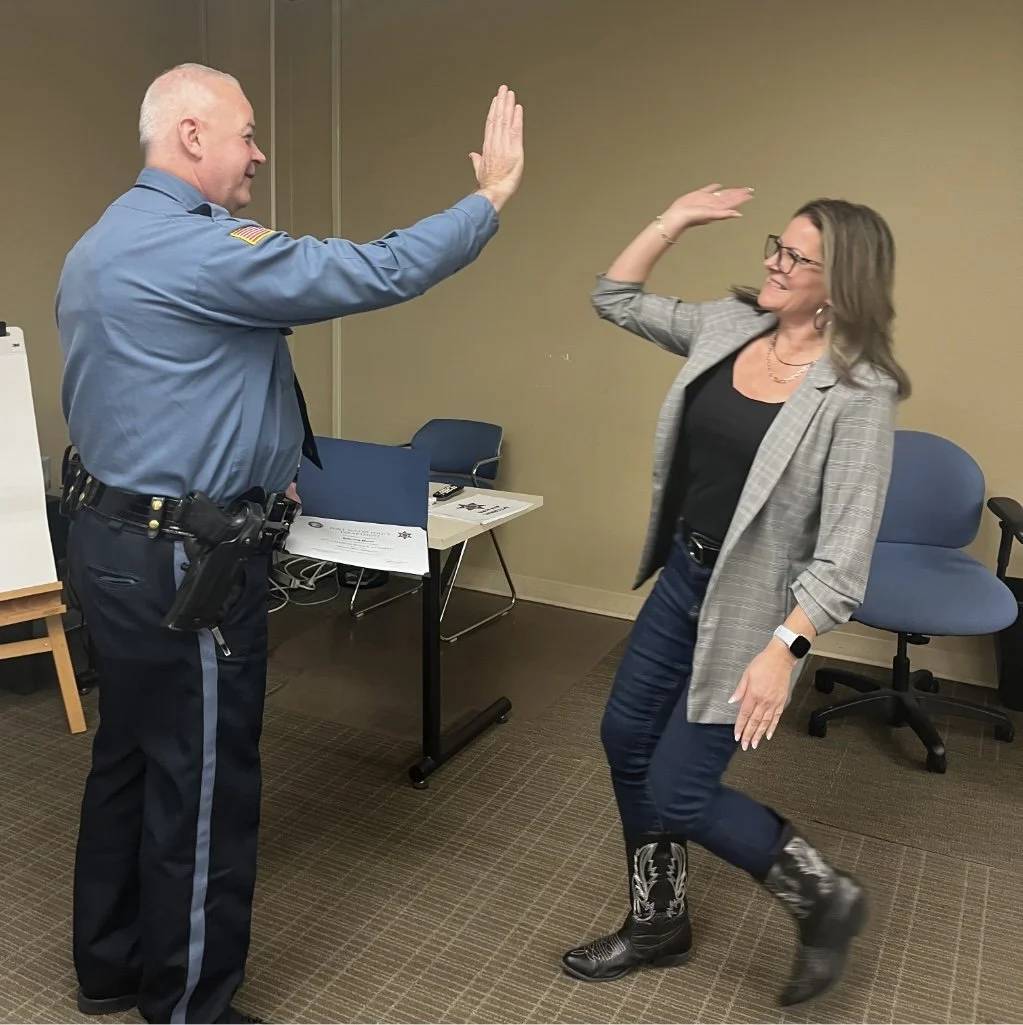
FWPD Police Chief Scott Caudill high fives Sabrina Moon post graduation from the Citizens Police Academy on 11/2025.